Welcome Committee
When I told my friends I was moving back to the suburbs for my mother, everyone did the same thing.
Head tilt. Soft voice.
“That’s so… generous of you.”
Like I was donating a kidney instead of my sanity.
My mother’s townhouse smells like lemon cleaner, overcooked broccoli, and the faint mildew of bad decisions. I gave up a rent-stabilized apartment and half-decent dating prospects to move into the unit across the hall, because “it’s not safe for her to be alone anymore.”
We said that a lot. Not safe. Like she’s a toddler with a driver’s license.
“Where are we going?” she asks from the tiny kitchen table, for the third time in ten minutes.
“We’re not going anywhere,” I say, trying to unstick a crusted pan from the sink. “I’m just unpacking.”
“Oh.” She squints at a Post-it on the fridge like it personally offended her. “You look tired.”
“Thanks.”
“You know what I say.” She leans back, robe gaping, the queen of stained linoleum. “Welcome to the real world.”
That’s her thing, like some Walmart version of Buddha. Your rent goes up? Welcome to the real world. Car needs a new transmission? Welcome to the real world. Your elderly mother can’t remember what day it is and leaves the stove on? Apparently also the real world.
People with Instagram therapists call it “invalidating.” My mother calls it “Tuesday.”
There’s a knock at my door across the hall. The movers, again. I jog over, leave her sitting at the table with her tea and a box of saltines she doesn’t remember opening.
My mattress is wedged in the stairwell like a beached whale. One mover wipes sweat with his forearm.
“We told you, lady, queen-sized doesn’t turn that corner. You want us to snap the frame?”
“No, I don’t want you to snap the frame.” I clench my jaw. I bought that bed when I thought my life was going somewhere besides back here. “Just… figure it out. Please.”
They don’t. We end up lowering it over the balcony with enough rope to kidnap a yacht. My new neighbor watches, arms folded, judging my ratchet suburban circus. My phone buzzes with Slack messages I’m ignoring.
By the time the mattress is in my bedroom, I’ve sweated through my shirt and mentally quit my job twice.
When I step back into Mom’s kitchen, the smell hits me first.
Burnt. Acrid. Smoky.
“Mom!”
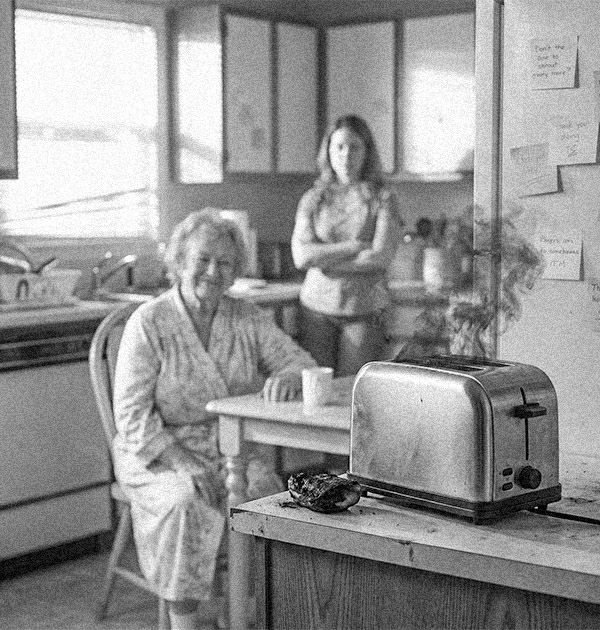
She’s still at the table, flipping through yesterday’s mail like it’s a murder mystery. Behind her, the toaster is exhaling a thin, ominous stream of smoke. Something inside glows a cheerful, apocalyptic orange.
I lunge for it, yank the plug, and smack the lever up. A blackened, fossilized object pops out and skids across the counter.
“What were you making?”
She looks at it like she’s never seen toast before.
“Huh,” she says. “Guess I got distracted.”
“No kidding.” I fling open the window, wave a dish towel like I’m signaling aircraft. The smoke alarm starts screeching its high-pitched judgment.
She watches me clatter around, opening cabinets, searching for a stepstool so I can smack the alarm into silence.
“You’re very dramatic,” she says over the beeping.
“Your kitchen was on fire.”
“It was not on fire.” She points at the toaster corpse. “That’s a light tan at best.”
I finally jab the button, blessed silence drops over the room.
My heart’s racing. My mind is already running through checklists: stove knobs, candles, the oven, everything she can forget to turn off.
“I can’t leave you alone for an hour,” I say, louder than I mean to.
Her eyebrows go up.
“You weren’t gone an hour,” she says. “You were gone eleven minutes.”
Of course she remembers that.
She taps the table with a fingernail, measuring me. I feel oddly like a misbehaving teenager, even though I pay both of our HOA fees now.
“You moved back here to boss me around?” she asks. Her tone is light, but there’s a tiny knife concealed in it. “Or because your little city life didn’t work out the way you thought?”
“That’s not fair.”
“Welcome to the real world.”
She says it Not Softly. Which is her version of caring.
I grab the ruined toast with a paper towel and drop it in the trash. It lands with a sad thunk on top of her collection of used tea bags.
“You could have burned the place down,” I say.
She shrugs.
“You could have burned the place down ten years ago,” she says. “When you left.”
I blink. That one doesn’t even make sense. This is what dementia does: it cuts up reality, tosses it in a blender, pours out metaphors no one ordered.
“I didn’t burn anything down,” I say. “I just… moved away.”
“And now you moved back.” She tilts her head. The kitchen light glints off her glasses. “So which prison is this one?”
“What?”
She waves at the boxes stacked by the doorway, my laptop on the counter, my phone buzzing, the mattress drama I just lived.
“You keep rearranging your prison and calling it a rescue,” she says. “From where I sit, looks like the same bars.”
Then she reaches for a saltine, takes a tiny, triumphant bite, and asks, “So. Where are we going?”
“We’re not going anywhere,” I repeat, because that’s what you do now. You repeat. You pretend the wisdom is just static.
But that line about bars scratches at the back of my head while I scrub the toaster.
I chalk it up to coincidence. Word salad. Eighty-four-year-old nonsense.
Whatever it is, it’s not about me.
Obviously.
Continue reading (Chapter-2) » Adult Supervision